


Over much of the last couple of years, the labor market has been in low-hire, low-fire mode. Job openings have fallen, but overall employment levels remain steady in spite of mounting concerns about the impact of AI and fears of recession. Nevertheless, workers have been taking precautions. With reports of many workers trending toward more “AI-proof” careers, this week, we’re looking at what types of career transitions are occurring in greater frequency.
Many workers are changing careers, not just jobs
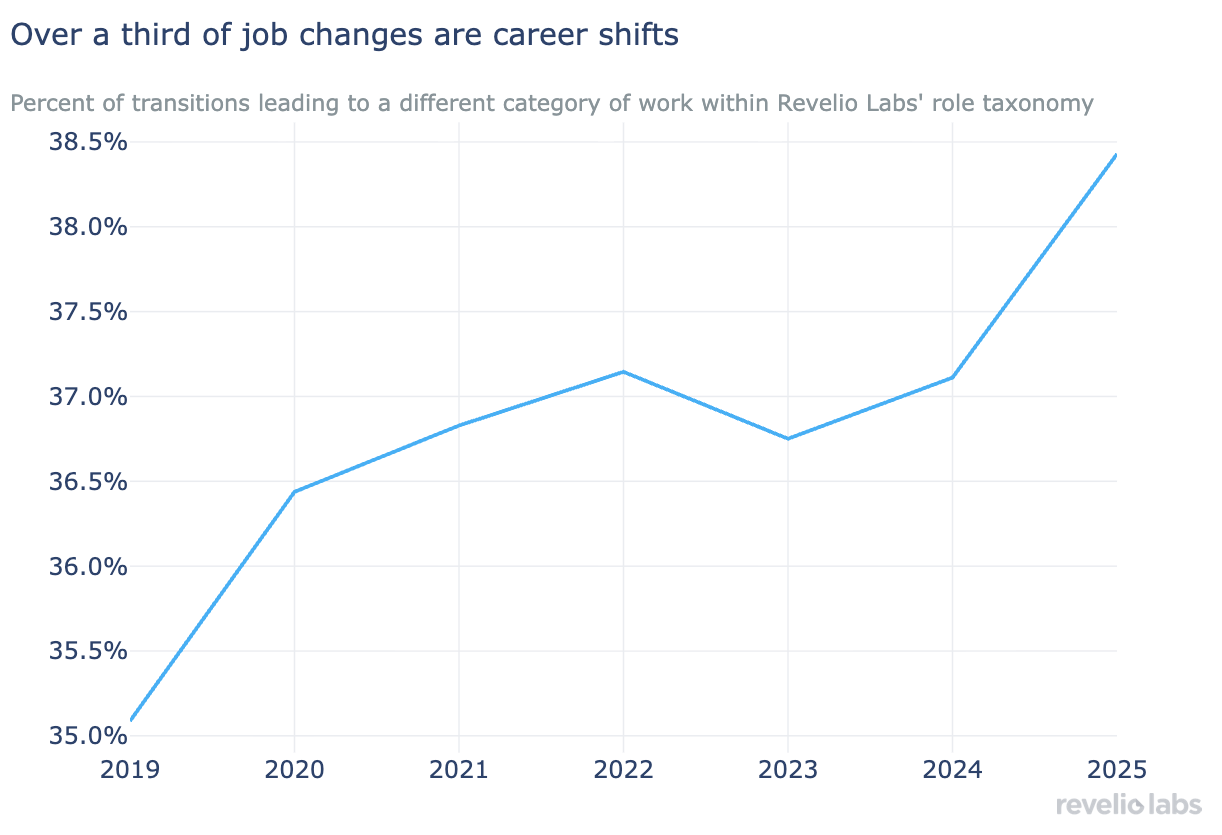
We first examine how the career-switching rate has changed in recent years. Using Revelio Labs’ workforce data and role taxonomy, we find that a greater percentage of job transitions entail a switch from one role type to another.
Put another way: In 2023, more than 63% of job-switchers came from the same role type—for instance, engineering to engineering, finance to finance, etc. By 2025, that figure dropped to about 61.5%, indicating that job-switchers are increasingly moving into different types of roles. The trend marks a divergence from the change in the overall job-switching rate, which has been found to be strongly procyclical.
AI roles are drawing a surge of career-changers
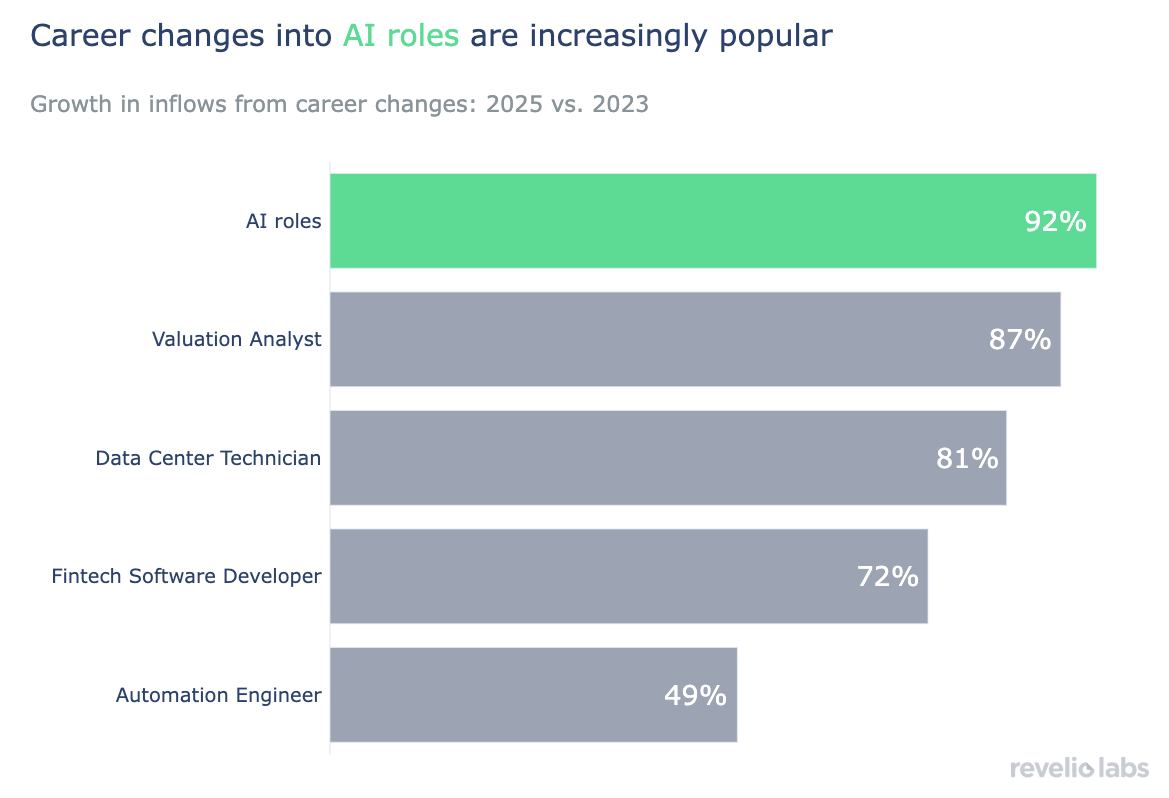
Some of the roles growing most quickly as a result of increased career switching are not surprising, as they are closely tied to AI. Going several levels down in Revelio Labs’ role taxonomy, we find that the role growing most quickly as a destination attracting job-switchers is AI project coordinator: someone who manages the development and implementation of artificial intelligence projects, ensuring alignment with organizational goals. Also in the top 5 are AI engineer and data center technician, two more roles that—as we show below—have surged amid the AI boom.
The jobs workers are leaving for AI
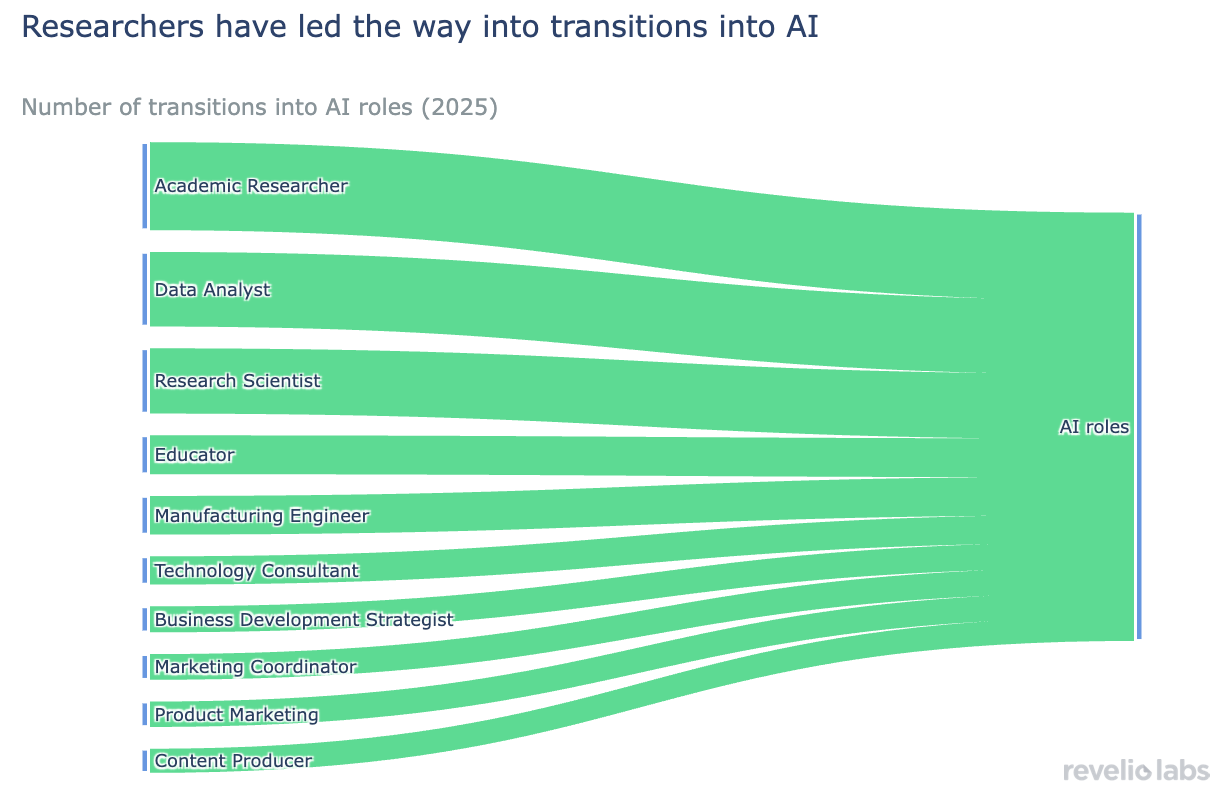
After identifying the roles that are most attractive to job-switchers, we next ask: Which roles are most frequently left behind in pursuit of AI project coordination and AI engineering careers? The most common sources are academia and research and data analysis, with manufacturing engineering not far behind. All of these roles involve many transferable skills and activities that strongly overlap with those in AI project coordination and AI engineering.
For instance, computational modeling and data analysis activities are strongly associated with research and data analysis roles as well as AI project coordination and AI engineering roles. Further down the list, we also see that transitions into AI careers are also relatively common among consulting and marketing roles—both of which have seen heavy AI adoption.
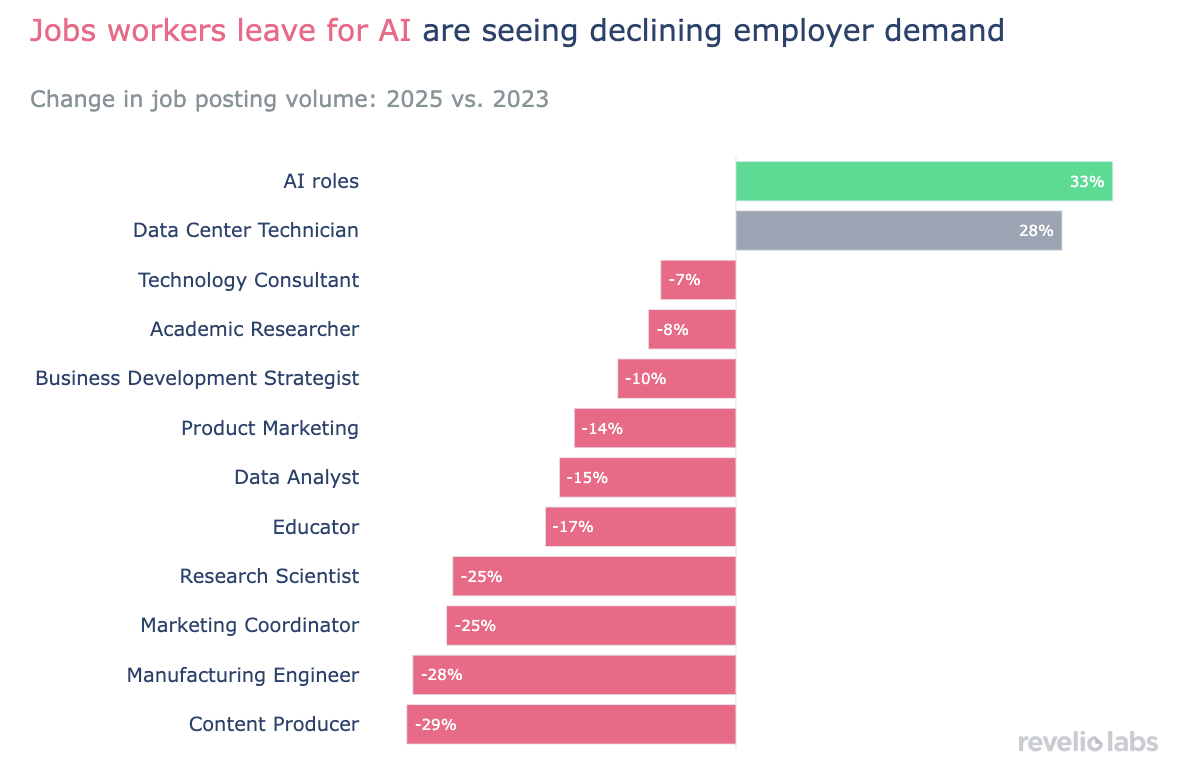
To better understand these transitions, we examine the push and pull felt by people in the above professions who are looking to transition into AI-driven roles. While job posting volumes for AI roles (AI project coordinator and AI engineer, collectively) were up last year by 33% relative to two years prior, and postings for data center technicians were up 28%, postings for the roles that most commonly feed into AI careers are all down, including academic researcher (-8%), data analyst (-15%), and research scientist (-25%). This helps explain why people in these roles are increasingly turning toward AI roles, where opportunities abound.
What AI leaders are now saying about jobs
These shifts are unfolding against a louder public debate about whether AI will eliminate jobs at all, and lately even its most prominent voices have softened that warning.
OpenAI's Sam Altman recently said he was "pretty wrong" about the technology's near-term impact, conceding that he "thought there would have been more impact on entry-level white-collar jobs being eliminated by now than has actually happened."
Anthropic's Dario Amodei, who once warned AI could wipe out half of white-collar jobs, has since reframed automation as a multiplier of output rather than a destroyer of work: "If you automate 90% of the job, then everyone does the 10% of the job," he said, and "the 10% kind of expands to be 100% of what people do." Goldman Sachs CEO David Solomon, who never bought into the “job apocalypse,” points to a century of precedent: "The United States has a long track record of creating new jobs in response to disruption."
Revelio data aligns more closely with this newly measured view. What we see is not workers being pushed out of the labor force but rather being reallocated within it, moving across career lines toward where demand is strong.
Are AI career changes happening inside companies?
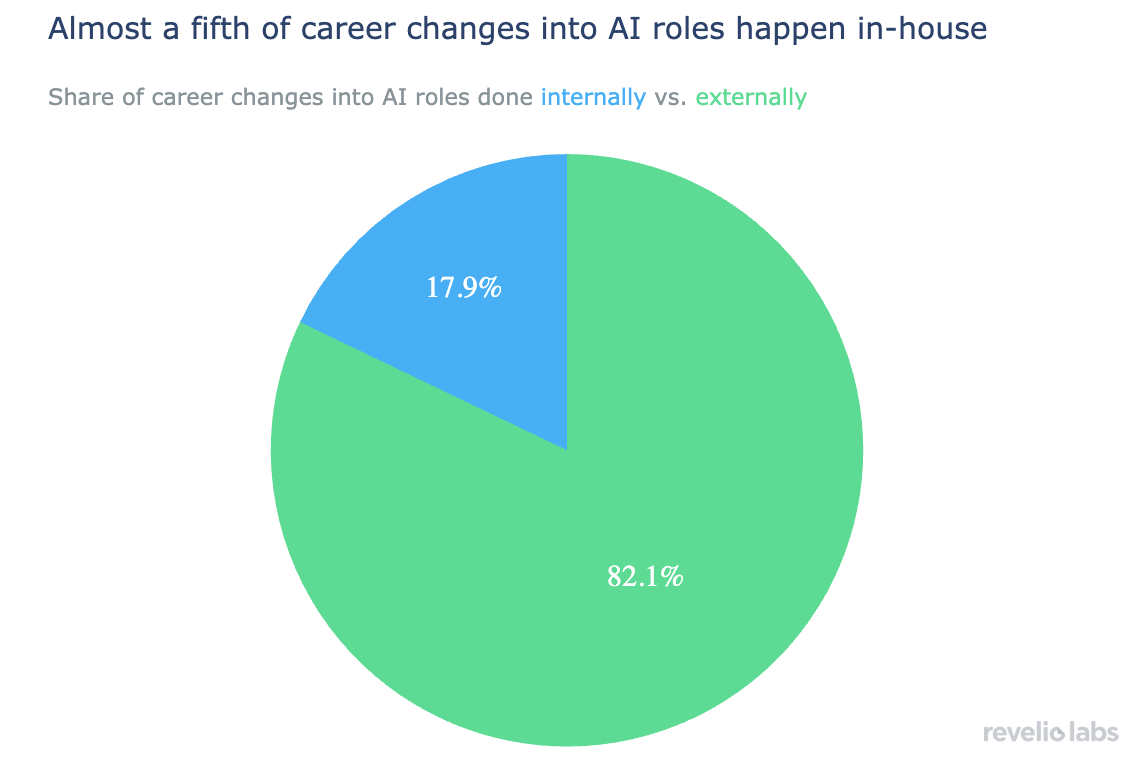
Are workers simply transitioning into new roles, or are they also changing companies at the same time? We then examine how many of these career changes into AI happen within companies, as opposed to between companies. We find that about 18% are done internally, within the same ultimate parent company.
Meanwhile, the overall rate of internal career changes into any role is quite a bit higher, at about 28%. This means workers transitioning into AI roles are less likely to do so internally than workers changing careers more broadly.
What this means for enterprises
Given the highly technical nature of AI work, the lower rate of internal transitions into AI roles is understandable. But for companies, it also points to a clear opportunity: building stronger internal pathways into high-demand roles can help retain and better deploy existing talent. As we’ve shown in the past, workers at companies with high rates of internal hiring also tend to report higher satisfaction.
Furthermore, we’ve also found that lateral career opportunities are more than twice as important as compensation in predicting employee retention. In upcoming work, we’ll take a closer look at the state of internal career transitions and what they reveal about how companies can better support mobility from within.
Free to reproduce with attribution and a link to reveliolabs.com.
Cite this article
- Plain text
- Revelio Labs, "AI Prompts a Rise in Career Changes," June 9, 2026.
- HTML
- Revelio Labs, "<a href="https://www.reveliolabs.com/news/macro/ai-prompts-a-rise-in-career-changes">AI Prompts a Rise in Career Changes</a>," June 9, 2026.
- Academic
- Boerner, D. (2026, June 9). AI Prompts a Rise in Career Changes. Revelio Labs.


