


Learning AI skills has emerged as a common piece of career advice as employers increasingly integrate AI into day-to-day work. This has led to the emergence and rapid expansion of new academic degrees, bootcamps, online courses, and professional certifications. Workers have responded en masse, hoping to stay relevant and incorporate the new technology at work. As the market for AI credentials explodes, it is important to ask: Are these AI certifications worth it?
A recent Brookings Institution working paper using Revelio Labs data offers important context. The authors found that non-degree credentials deliver meaningful wage returns – but only when they are relevant to the worker's occupation. The findings from this study set the stage for the current AI certification wave. Are workers pursuing credentials that are genuinely relevant to their jobs, or are they accumulating low-value certifications that signal engagement with AI without delivering meaningful returns?
This week, we use Revelio Labs’ data to track the AI certification boom. We identify AI certifications via a keyword search of certification titles on workers’ online professional profiles. We examine who is getting certified, what they are learning, and whether the certifications actually pay off in terms of career outcomes. We exclude academic degrees from the analysis and focus on non-degree certifications and courses recorded on users’ online professional profiles.
AI Upskilling Trends
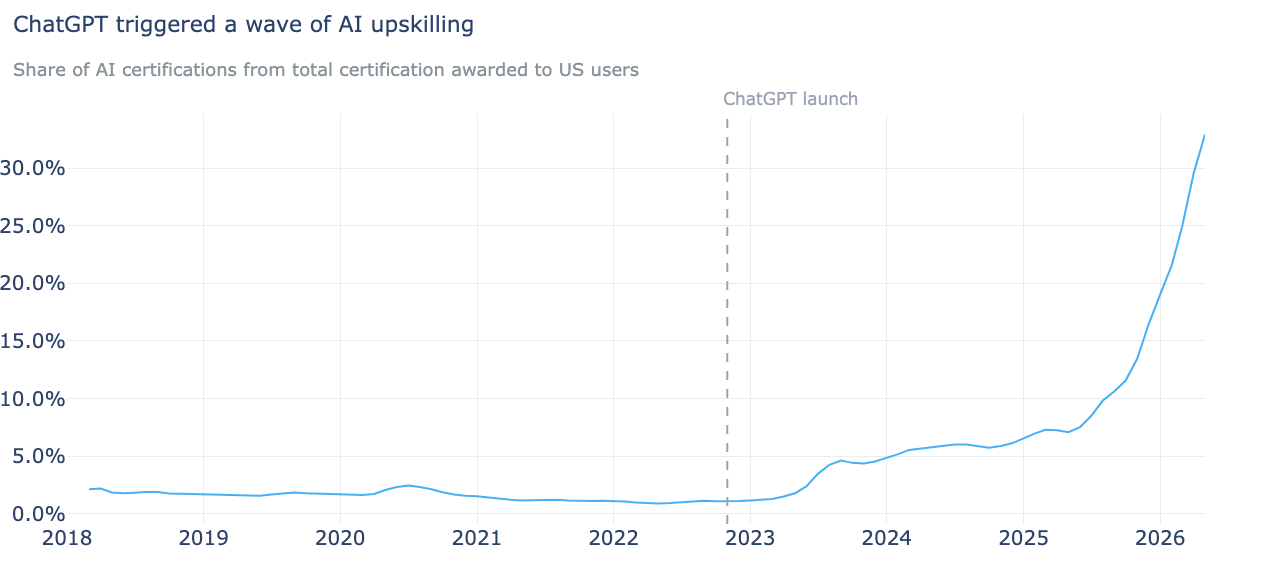
Between 2018 and 2023, the share of the AI-related certifications hovered around 1-2% of all professional certifications reported by workers. The launch of ChatGPT at the end of 2022 changed that. Within months, the share of AI certifications began climbing steeply. By 2024, it had tripled, and by 2026, it had reached nearly 30% of all certifications: a 20x increase from pre-ChatGPT levels. The release of ChatGPT and the diffusion of the technology across the economy made AI upskilling a broad-based workforce response, not a niche activity for developers and data scientists.
There is a good reason for this sudden appetite for certification: employer expectations are changing rapidly. According to a Spring 2026 Job Outlook survey by the National Association of Colleges and Employers (NACE), more than one-third of entry-level job openings now explicitly require AI skills. That demand nearly tripled in just a six-month window since Fall 2025. Furthermore, NACE found that 60% of employers are already assigning AI-driven projects to interns. Basic AI proficiency has rapidly transitioned into a core baseline expectation for early-career talent.
In order to understand the surge in AI certifications, we build a two-level taxonomy for over 500,000 unique AI-related certification names from workers’ profiles. Certifications are first grouped into six broad domains, then into more specific subcategories. The figure below shows the main categories and their largest subcategories.
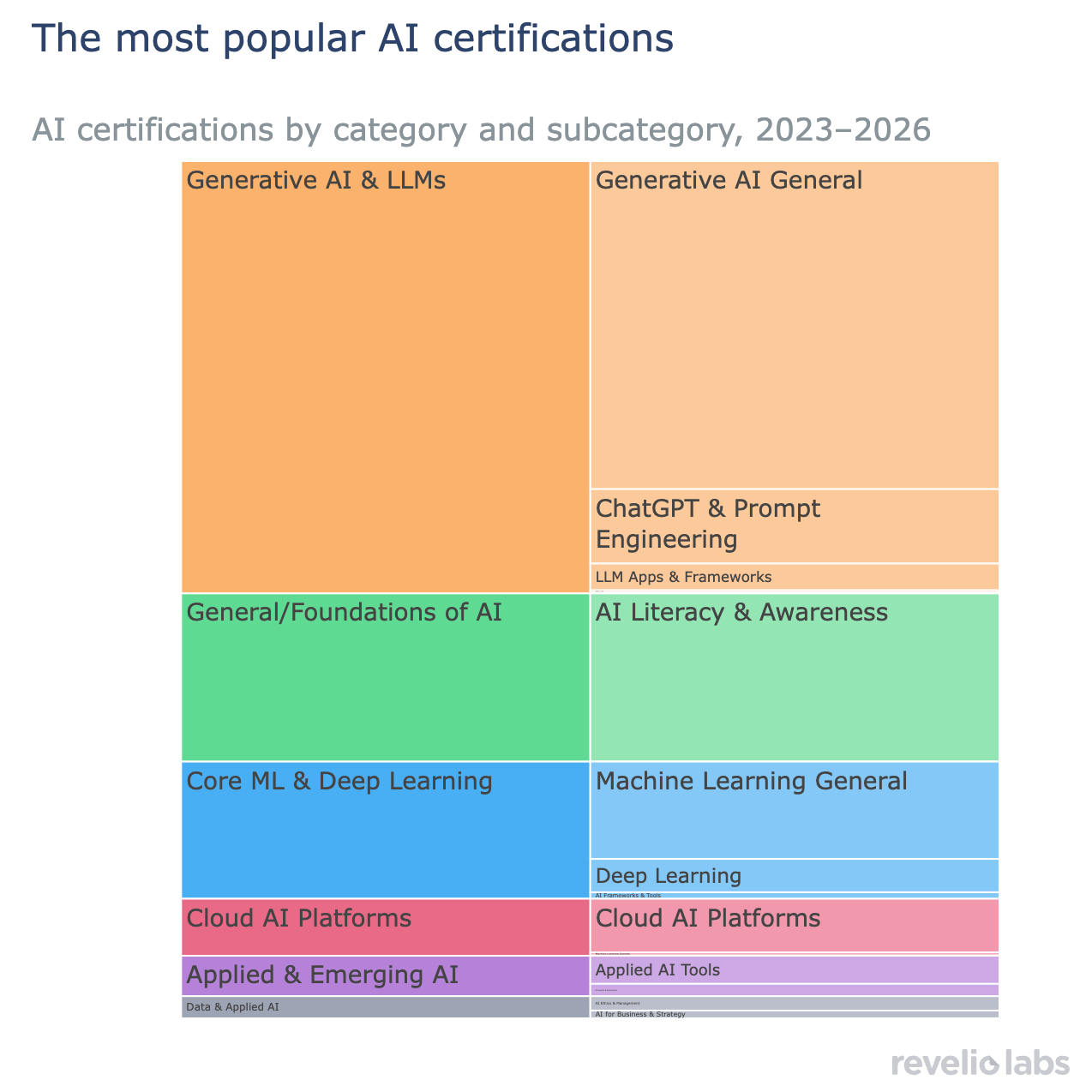
The main categories of AI certifications are:
- Generative AI & LLMs: Certifications specifically about GenAI, including ChatGPT, prompt engineering, large language models, LangChain, diffusion models, and foundation model tools
- General AI: introductory and literacy-level certifications, such as "AI for Everyone," "Elements of AI," and similar awareness programs
- Core Machine Learning & Deep Learning: the traditional backbone of AI, including machine learning, neural networks, deep learning frameworks like TensorFlow and PyTorch, computer vision, and NLP
- Cloud AI Platforms: vendor-specific certifications from AWS, Azure, Google Cloud, and IBM
- Data & Applied AI: certifications related to data science, analytics, AI ethics, and AI for business strategy
- Applied & Emerging AI: Certifications where AI is applied to a specific domain, such as AI agents, productivity tools, and domain-specific applications. In these certifications, the users are learning how to use AI with tools inside their fields, such as Canva and Excel
Changes in the Types of AI Certifications
The relative importance of AI-related certifications has shifted remarkably over the past few years. Before ChatGPT, Core ML & Deep Learning certifications dominated, accounting for over 90% of all AI certifications.
With the release of ChatGPT, the composition changed dramatically. The share of Core ML & Deep Learning certifications fell from around 90% to under 5%. In its place, two categories dominated: Generative AI & LLMs surged to become the single largest group, while entry-level General AI certifications captured a growing share as workers across all industries sought a basic foothold in the technology. It is important to note that the absolute number of machine learning certifications hasn't collapsed. Rather, the market has been flooded with GenAI certifications that are accessible to more workers with less technical knowledge.
Who is Issuing GenAI and AI Foundations Certifications?
The supply side of the AI certification boom is just as important to consider as the demand side. From this point forward, we narrow our focus to the three categories that have driven the post-ChatGPT surge: Generative AI & LLMs, AI Foundations, and Applied and Emerging AI. These are the certifications that have flooded the market since 2023. They are accessible, broadly targeted credentials aimed at workers across all industries and backgrounds, not just specialists. Together, they represent the democratization of AI upskilling.
Looking at GenAI and AI Foundation certifications issued between 2023 and 2025, one thing stands out immediately: LinkedIn Learning dominates. LinkedIn’s learning platform accounts for over 45% of all AI certifications, more than all the other tech giants, cloud platforms, and learning platforms combined.
LinkedIn Learning certifications are generally free for LinkedIn Premium subscribers and are frequently offered at no cost through employer partnerships with LinkedIn, which dramatically lowers the barrier to entry compared to other programs. This accessibility makes LinkedIn the default starting point for workers who want to signal AI awareness without committing to a structured curriculum. These certifications are the broadest, most basic layer of upskilling. Millions of workers acquire a basic credential to demonstrate engagement with AI, even if the depth of learning is limited.
Among tech giants issuing AI certifications, Google leads with 7%, followed by Microsoft and IBM at 4-5%. These companies have strong incentives to certify the workforce on their own AI tools and platforms. This reflects the rapid integration of AI content into the many day-to-day tools workers use, signaling that AI upskilling is permeating traditionally non-technical professional communities. Learning platforms like Coursera and Udemy also occupy a notable share of the market for GenAI certifications.
Workers in AI-Exposed Jobs Are Leading the Charge
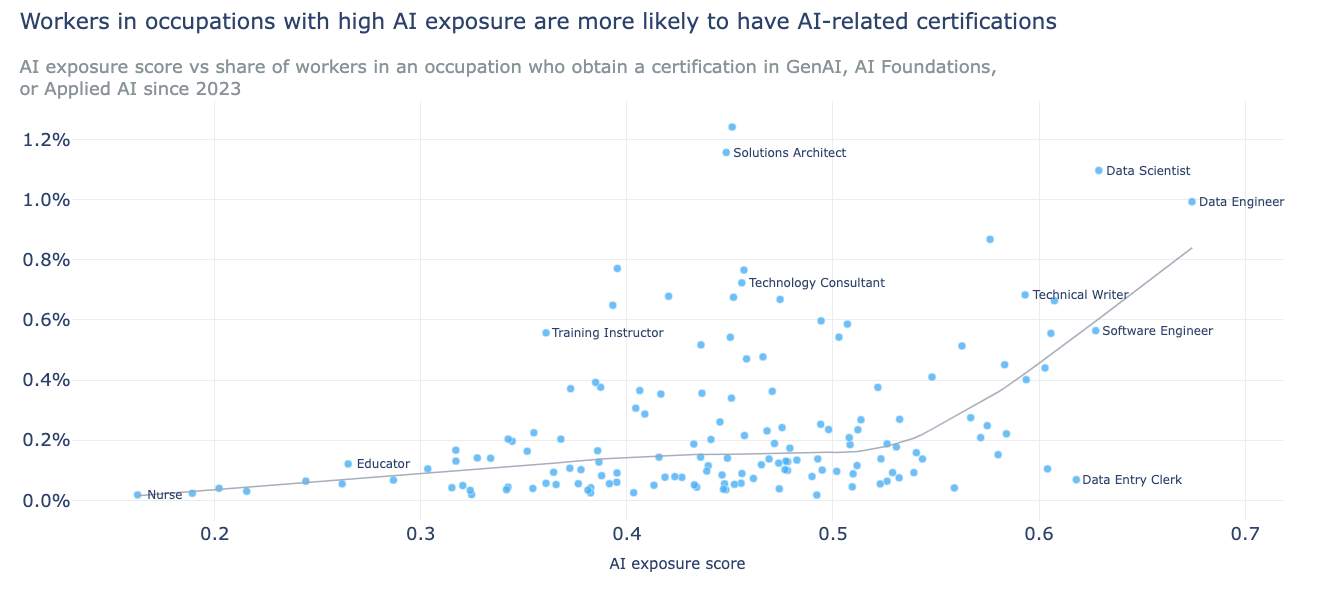
To understand who is seeking AI certifications in GenAI, General Foundations, and Applied and Emerging AI, we observe workers’ occupation at the time of obtaining the certification. Using Revelio Labs’ AI exposure score, we find a strong positive relationship between AI exposure and certifications. Workers in higher-exposure occupations are significantly more likely to obtain an AI certification.
The upward trend is clear across the full distribution of occupations. Nurses, sitting at the low-exposure end of the spectrum, almost get no AI-related certifications. As exposure rises, for occupations such as training instructors, technology consultants, and solutions architects, the share of workers with certifications in GenAI or general foundations climbs steadily. At the high-exposure end, solutions architects and AI professionals certify at over 1% of their workforce, the highest rates in our sample.
The trend line in the chart captures this overall relationship. Certification rates are roughly flat at low exposure levels, then accelerate noticeably once the AI exposure score crosses 0.5. This indicates that the link between AI exposure and certification-seeking strengthens notably among the most exposed occupations.
Who Is Most Likely to Obtain AI Certifications?
Before asking whether AI certifications pay off, it's worth asking who is pursuing them in the first place. Are these workers already high performers seeking to stay ahead, or are they struggling workers trying to protect their jobs?
To address this question, we use salary as a proxy for performance, after controlling for factors such as occupation and seniority levels. At first glance, the data suggests positive selection into getting an AI certification. After controlling for occupation and seniority level, AI certification holders earn, on average, an $8,000 salary premium compared to non-certification holders. In other words, within any given occupation and seniority level, the workers choosing to get certifications are those who are already earning more than their peers.
But, the picture becomes more nuanced when we break it down by AI exposure level. In low-exposure occupations, the positive selection story holds. Certification takers in these roles generally earn a large salary premium compared to their peers. These are workers who face relatively limited AI disruption to their day-to-day tasks, yet are proactively investing in AI skills. They look like proactive upskillers.
Among those with high-exposure occupations, certification takers still earn a salary premium relative to their non-certifying peers in the same role and seniority, but the difference is notably smaller. This is consistent with a defensive motivation: workers who feel most at risk within their role are the ones most urgently seeking credentials, suggesting that for the most exposed workers, certification is less about ambition and more about protection.
Does Getting an AI Certification Help Workers with Job Mobility?
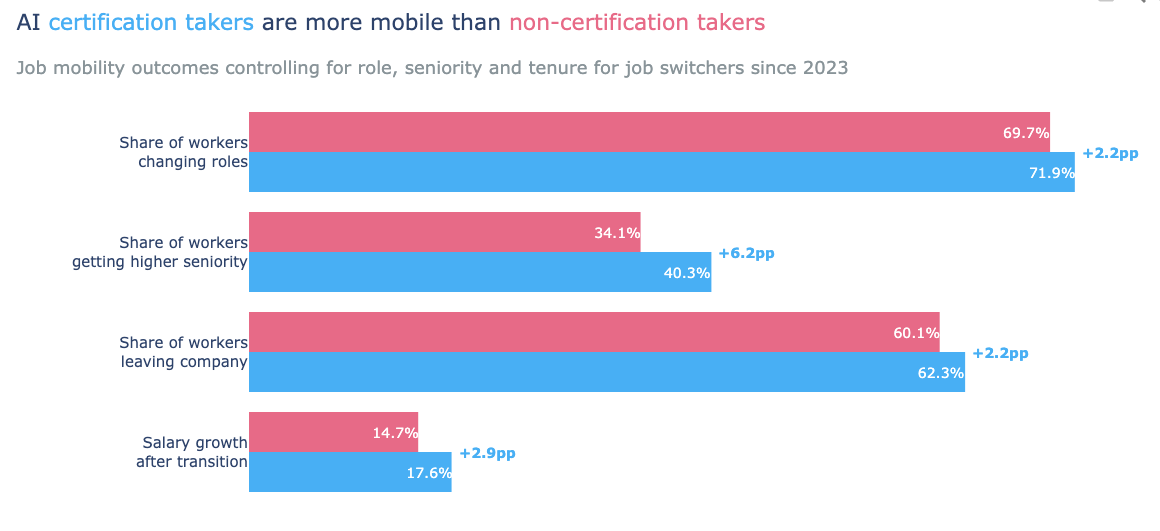
To assess whether AI certification improves job mobility, we track outcomes for workers who changed jobs after obtaining an AI certification between 2023 and 2025. Specifically, we look at whether, in their next job transition, they changed roles, climbed the seniority ladder, changed employers, or experienced higher salary growth. To measure this effect, we construct a control group of non-certification takers using propensity score matching on role, seniority, tenure, salary, AI exposure, and state. We then compare outcomes between the two groups, controlling for role, seniority, and tenure.
The results are consistently positive across every dimension we measured. Certification takers are more likely to change roles in their next transition — 72.5% versus 68.6% for non-certification takers — a 3.9 percentage-point gap. They are more likely to move up the seniority ladder: 38.9% received a higher-seniority role in their next position compared to 33.9% among non-certification takers, a 5 percentage point difference. They are also slightly more likely to leave their current employer, suggesting that certification opens doors beyond their existing organization. And when they transition, certification takers see their salary grow by 23.4% on average in their next position, compared to 18.2% for non-certification takers — a 5.2-percentage-point advantage.
That said, an important caveat applies. As we showed earlier, certification takers are not a random sample. They are already higher earners within their roles in most occupations. Propensity score matching does not fully eliminate this gap. Some of the mobility advantages we observe may reflect the underlying ambition and capability of those who choose to certify, rather than the effect of certification itself. Disentangling selection from the real certification effect remains a challenge, and results should be interpreted as correlations rather than causal.
The AI certification boom provides an important labor market signal. Many workers are taking certifications to demonstrate AI competence, and even just literacy, betting that it will matter for their careers. They are largely right. Workers who certify are more mobile, more promotable, and better compensated when they make a job transition. The GenAI wave has democratized AI upskilling, giving rise to LinkedIn certifications that have brought millions of workers into the conversation who would never have enrolled in a traditional ML course.
This raises an important question for employers and policymakers: is the current certification ecosystem actually bridging the AI skills gap, or is it primarily serving workers who were already well positioned to adapt?
As AI continues to reshape work, workers who thrive will likely be those who move beyond basic literacy-level credentials toward hands-on and application-specific skills. The early signs are already visible in the data: LLM Apps & Frameworks, AI Agents, and domain-specific AI tools are the fastest-growing subcategories of certifications heading into 2025 and 2026. The next wave of AI upskilling may be less about understanding what AI is and more about knowing what to build with it.
Free to reproduce with attribution and a link to reveliolabs.com.
Cite this article
- Plain text
- Revelio Labs, "Are AI Certifications Worth It?" June 23, 2026.
- HTML
- Revelio Labs, "<a href="https://www.reveliolabs.com/news/social/are-ai-certifications-worth-it">Are AI Certifications Worth It?</a>" June 23, 2026.
- Academic
- Abdelwahed, L. (2026, June 23). Are AI Certifications Worth It? Revelio Labs.


